A youth-led access campaign in Surrey, England. Founded 2026.
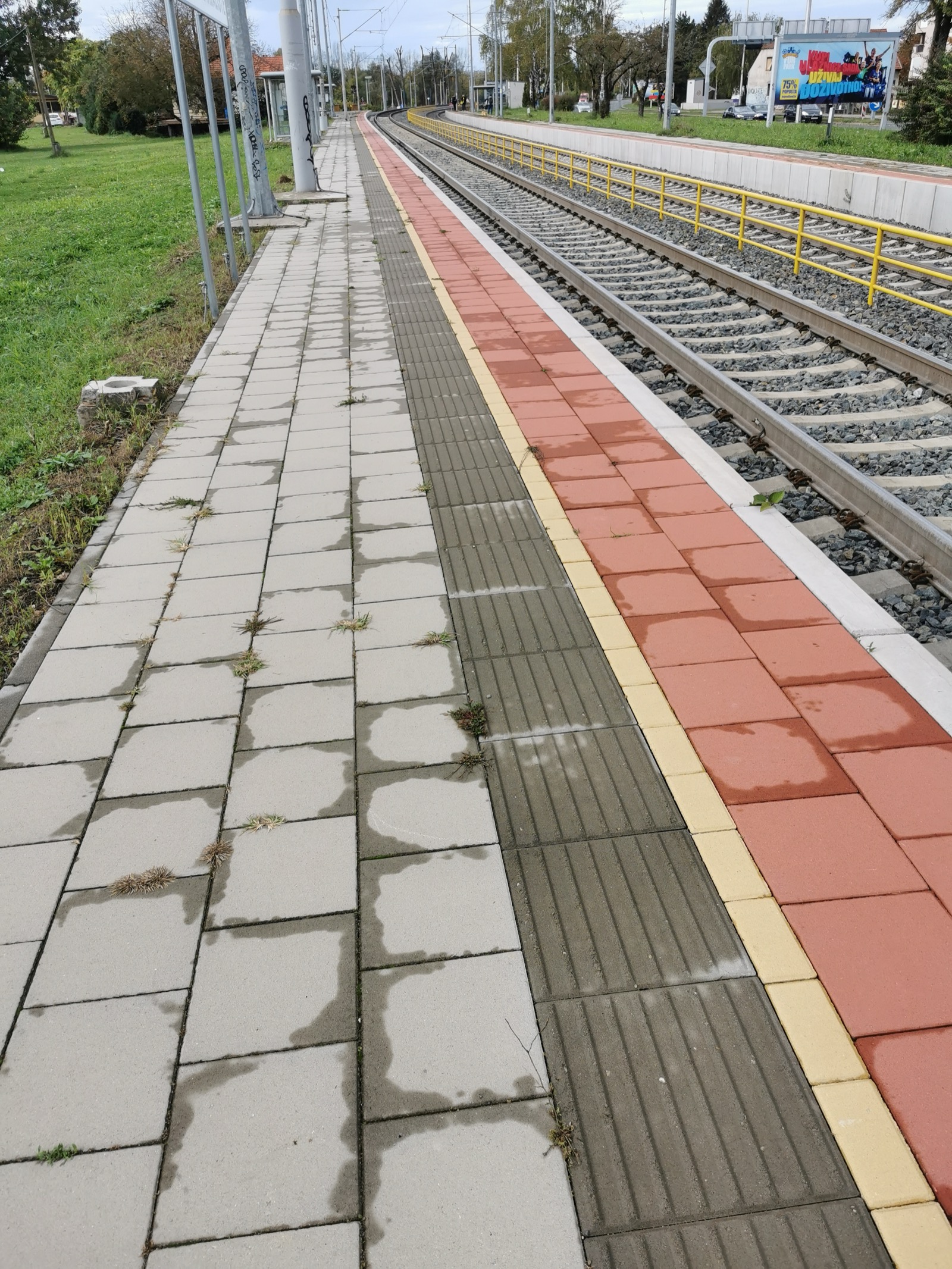
Tactile paving at a station platform, an access feature read by foot. Photograph: Mnalis, Wikimedia Commons, CC BY-SA 4.0.
Every accessible toilet should have a map you can read with your hands and ears.
My mission is to replace the anxiety of navigating unpredictable public restrooms with independence and confidence for the blind and visually impaired community. As a 15-year-old advocate, I am campaigning to introduce low-cost tactile maps outside accessible toilets so users can feel the layout before entering. Beside each map, a QR code plays an audio guide, so everyone can hear the room described too. Join my movement today by signing the petition on this website, or by emailing me to trial these life-changing tools.
Welcome to our campaign. We believe that true accessibility means independence, dignity, and confidence for everyone in everyday life.
For a blind or visually impaired person, entering a public accessible toilet shouldn't be a stressful guessing game. Because every single restroom layout is different, navigating them without sight causes immense anxiety and serious safety risks, like mistaking a critical emergency pull-cord for a simple light switch.
We are here to change that by introducing a new, practical standard: tactile maps installed directly outside accessible toilets.
Our tactile maps use raised textures and clear symbols, allowing users to completely map out the room with their fingertips before they even step inside. At a single touch, a user can confidently locate the toilet, sink, flush, and emergency features. Beside each map is a QR code. Scan it and your phone plays a spoken description of the room, so people who don't read braille can use the map too, and braille readers can follow along by touch. Venues can offer more than one language. This simple, structural change has a massive, immediate impact on a person's autonomy and peace of mind.
The problem
An accessible toilet is meant to be the one room a disabled person can use without help. For a blind or partially sighted person it is often the opposite. The layout is different in every building. The flush might be a button on the wall, a lever behind the seat, or a sensor. The soap, the towel, and the dryer are wherever the fitter put them. And one control is not like the others: the red emergency cord, which should reach the floor, is frequently tied up out of the way, or sits a hand's width from the light switch, so the two get confused.
Sighted users solve all of this in a second by looking. A blind user has to map the room by touch, fixture by fixture, often while the door is the only thing they are sure of. The wider barrier is documented. In RNIB's 2025 report on pedestrian journeys, In My Way, a survey of nearly 1,200 blind and partially sighted people across the UK, 61 per cent said they cannot make all the journeys they want or need to make, and only 9 per cent strongly agreed they feel safe walking independently in their own neighbourhood.1 An inaccessible toilet sits at the end of every one of those journeys.
The scale is large and growing. In the United Kingdom around two million people live with sight loss, a figure projected to roughly double, to over four million, by 2050 as the population ages.2 Roughly 340,000 people are registered blind or partially sighted.2 The legal duty already exists: the Equality Act 2010 requires "reasonable adjustments" so disabled people are not put at a substantial disadvantage.3 A tactile map is a small, cheap, reasonable adjustment that no one has standardised.
61%
of blind and partially sighted people cannot make all the journeys they need (RNIB, In My Way, 2025)
9%
strongly agree they feel safe walking independently in their neighbourhood (same survey)
~2m
people in the UK living with sight loss, set to roughly double by 2050
Figures are public, cited below. They describe the population this campaign serves; they are not claims about this campaign's own reach.
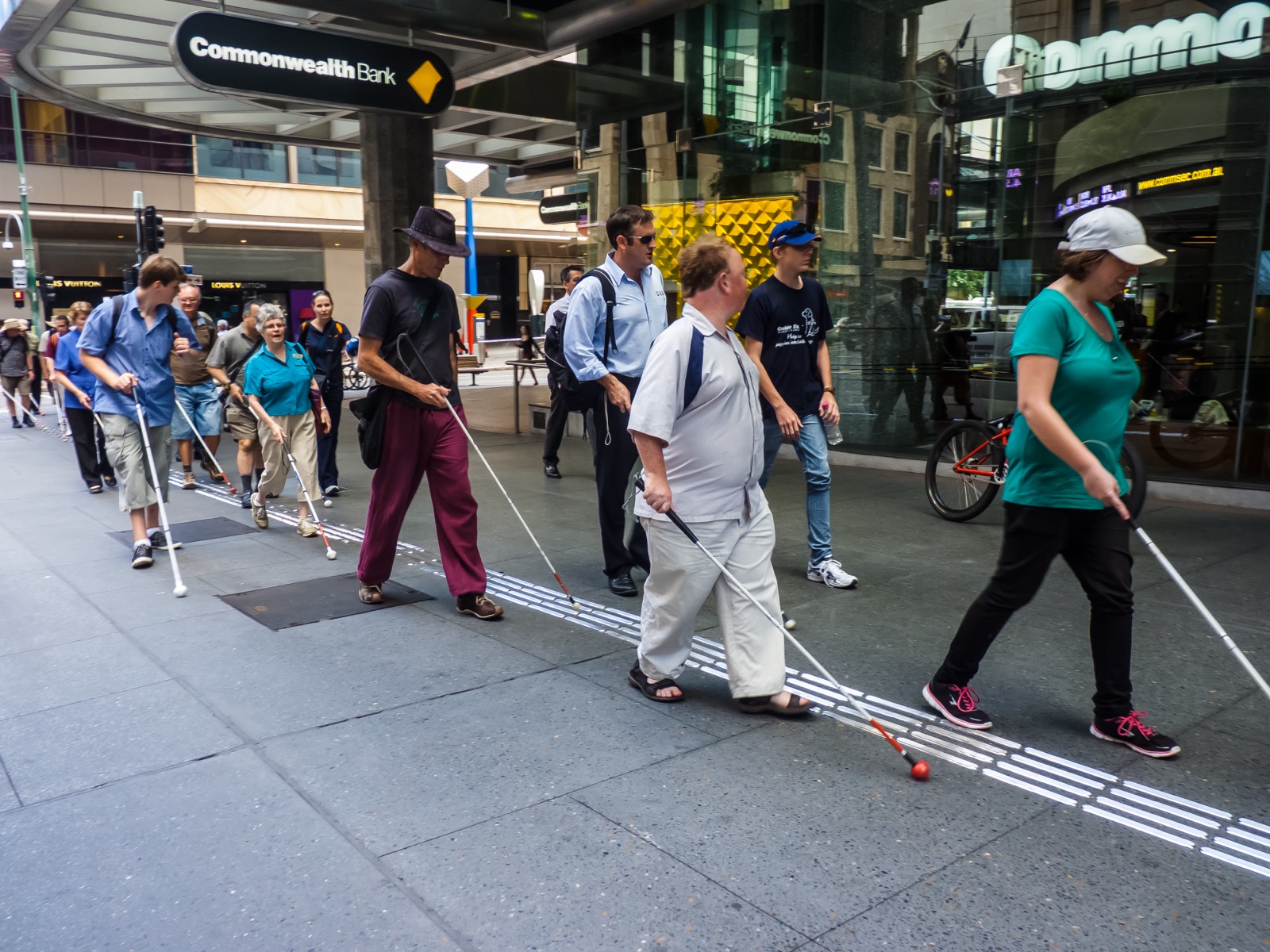
White cane users in a town centre on International White Cane Day. The cane reads kerbs and surfaces; a building's interior controls it cannot. Photograph: John Robert McPherson, Wikimedia Commons, CC BY-SA 4.0.
My story, by Hayley X.
Hi, I'm Hayley. I am a 15-year-old blind advocate, and I know firsthand what it feels like to face an environment that wasn't designed with me in mind.
Living with a visual impairment means constantly adapting to a world built for sight. But I believe that basic daily tasks shouldn't require a leap of faith or a compromise on safety. Navigating public spaces independently is a right, not a privilege.
I started this campaign because I wanted to turn my personal daily frustrations into a practical solution for millions of people. My goal is to fight for greater accessibility, confidence, and independence for the blind and visually impaired community. By introducing these low-cost tactile maps, we can eliminate the anxiety of the unknown and replace it with true autonomy. This isn't just about signs; it's about equality, safety and empowering people to move through the world without fear.
What a tactile bathroom map is
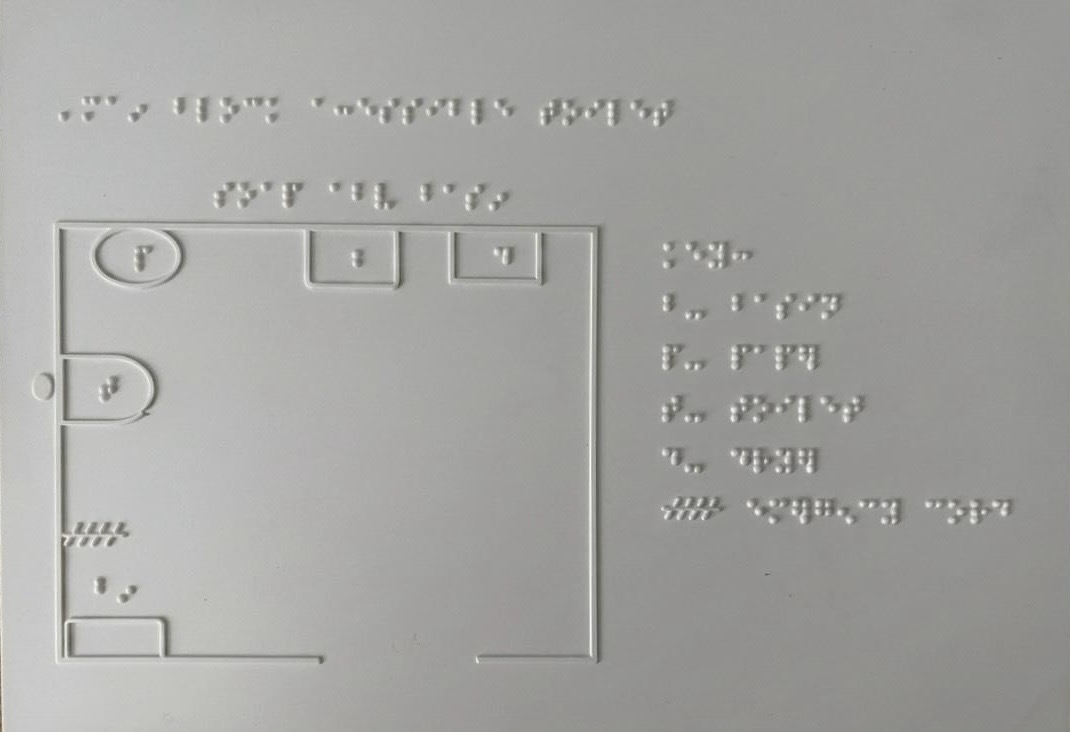
A tactile map is a raised-line plan of the room, mounted on the toilet door, that a blind or partially sighted person reads by touch before stepping inside. Lines and shapes are raised so fingers can follow them. Every fixture carries a braille label. Essential fixtures feature standardised signs and braille keys on the right side, as shown below:
Figure 2. Hayley's physical prototype of the tactile map: the raised room plan on the left, read fixture by fixture with the fingertips, and the braille legend on the right. A QR code beside the map plays an audio guide of the same room. Photograph supplied by Hayley.
Read the room with your hands and ears.
A QR code beside the tactile map opens a spoken description of the room. People who do not read braille can listen, while braille readers can follow the map by touch. Venues can offer recordings in different languages.
Real change requires community momentum. We are actively gathering support to prove to decision makers just how vital this standard is.
Sign the petition on this website. The global petition is live now on Change.org, and anyone, anywhere, can sign it. It calls on public venues, starting with our school and Surrey County Council, to fit a standard tactile map in every disabled toilet they manage.
Partner with us by contacting my email. If you run a school, a library, a leisure centre, a council building, or any public venue and want to trial the maps, contact me at info.sightlines@gmail.com. The design and the fitting guidance in the toolkit are free.
RNIB, In My Way: the unnecessary and dangerous barriers on our streets (2025), a survey of nearly 1,200 blind and partially sighted people across the UK. 61 per cent cannot make all the journeys they want or need to make; 9 per cent strongly agree they feel safe walking independently. rnib.org.uk.
RNIB, "Key information and statistics on sight loss in the UK." Over two million people in the UK live with sight loss, projected to roughly double, to over four million, by 2050; around 340,000 people are registered blind or partially sighted. rnib.org.uk.
Equality Act 2010, sections 20 to 22 (the duty to make reasonable adjustments). legislation.gov.uk.